
Want to listen?
Listen: Local SEO Services: 6 Expert Secrets Your Competitors Hope You Never Discover
On this page
If your competitors are ranking above you on Google Maps right now, there's a good chance they're using local SEO services you haven't tapped into yet. It's not because they're smarter, it's because they got the right help first. For Toronto and GTA business owners, the gap between showing up on page one and being invisible can mean tens of thousands of dollars in monthly revenue. The good news is that the strategies driving those results aren't magic. They're methodical, they're learnable, and we're about to hand you six of the most underused ones in this market.
Local SEO services are the strategies a business uses to rank higher in geographically targeted searches, the Google Maps local pack, "near me" queries, and city-specific results, by optimizing its Google Business Profile, local citations, online reviews, hyperlocal content, and on-site technical signals. Done well, they put your business in front of customers at the precise moment they're ready to call, book, or walk through your door. Below, we break down six of the highest-impact tactics, then answer the two questions every owner asks: what it costs and how long it takes.
Why Are Local SEO Services a Different Game in the GTA?
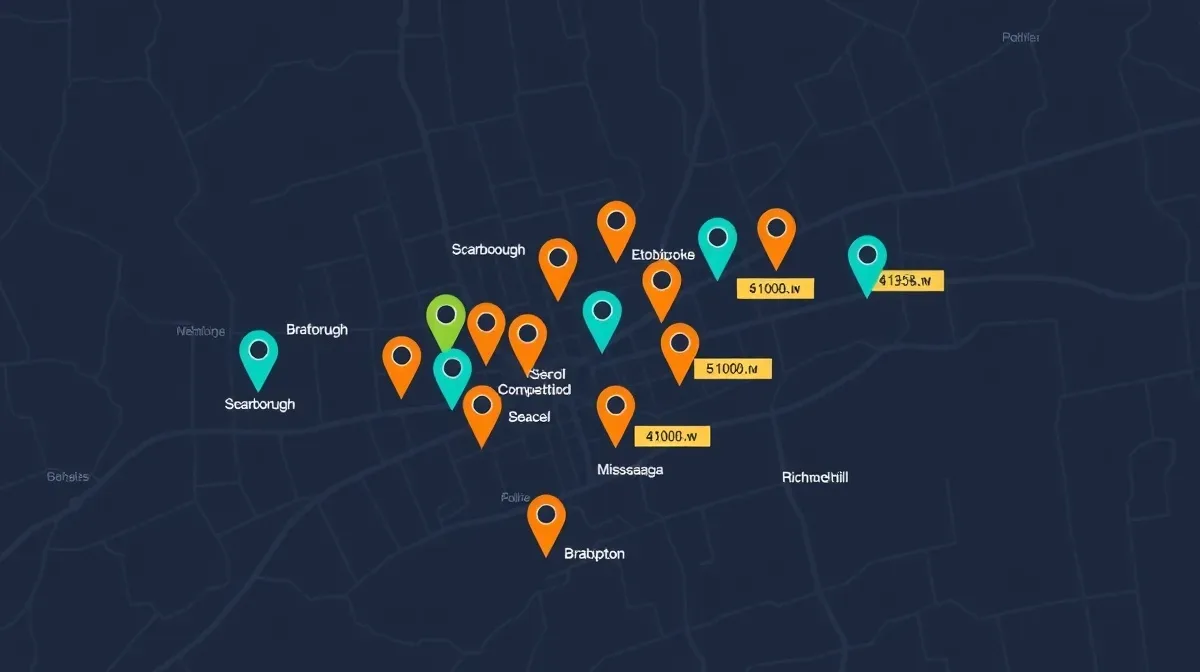
Toronto isn't just a big city, it's a collection of intensely competitive micro-markets. Scarborough, Etobicoke, Mississauga, Brampton, Richmond Hill: each neighbourhood has its own search behaviour, its own density of competitors, and its own customer expectations. A generic SEO approach built for a mid-size American suburb simply doesn't translate here. If you want the city-wide picture of how the map pack works first, our guide to local SEO in Toronto covers the fundamentals, and here we go a level deeper into the specific tactics that move the needle.
According to BrightLocal's 2025 Local Consumer Review Survey, 98% of consumers used the internet to find information about local businesses in the past year. More telling: 78% of local mobile searches result in an offline purchase within 24 hours, according to Google's own Think with Google research. That's not a funnel, that's a trapdoor straight to revenue.
The challenge is that most GTA business owners are still treating local search like it's 2019. They claim a Google Business Profile, toss in a few keywords, and wait. Meanwhile, competitors who've invested in professional local SEO services are running circles around them with strategies that most people have never even heard of.
Your competitors are showing up where your customers are searching, and every day that gap stays open, it costs you. Let's fix that with a free, no-obligation local SEO audit built specifically for your Toronto-area business.
Secret #1: Entity-Based Optimization, Google Doesn't Just Read Keywords Anymore
Google's understanding of content has moved well beyond keyword matching. Its Knowledge Graph now maps entities, people, places, businesses, and concepts, and evaluates how credibly your business fits within a relevant web of related entities. For a plumber in Vaughan, that means Google isn't just checking whether your website says "plumber Vaughan." It's asking: does your website, your Google Business Profile, your citations, and your backlink profile all consistently describe the same business, in the same location, with the same specialization?
This is why NAP consistency (Name, Address, Phone Number) matters so deeply, but it goes further. Your schema markup, your "About" page copy, the anchor text pointing to your site, and even your social profiles all contribute signals to this entity picture. When those signals are coherent, Google rewards you with higher local pack placement. When they're fragmented, even a technically strong site can stall. It's one of the first things a solid local SEO services provider will audit.
Prefer to listen? We unpack entity-based optimization and the rest of these local SEO secrets in the short video below.
Secret #2: Your Google Business Profile Has Features 90% of Businesses Ignore
Most business owners treat their Google Business Profile (GBP) like a listing, fill in the basics, post occasionally, and forget it. The businesses dominating local search in Toronto treat it like a living marketing asset. There's a meaningful difference between those two approaches.
GBP's Q&A section is one of the most overlooked ranking opportunities in local SEO services today. You can populate your own questions and answers, effectively pre-loading the content Google needs to surface your business for specific queries. If someone searches "does [your business] offer same-day service in Mississauga," and that exact phrase exists in your Q&A, your listing has a significant advantage.
Beyond that, GBP Posts with keyword-rich copy, regularly updated business attributes, and geotagged photos (with accurate EXIF location data) all compound over time to signal relevance and activity to Google's local algorithm. These aren't one-time tasks, they're ongoing signals that separate active businesses from stagnant ones.
Source: Illustrative, based on industry case studies and Sinreh Digital client benchmarks
Advanced GBP optimization consistently correlates with top-3 local pack placement across competitive Toronto verticals.
Secret #3: Hyperlocal Content Is Not What You Think It Is
When most people hear "local content," they imagine a thin blog post titled "Best Dentist in North York" stuffed with location names. That's not hyperlocal content, that's keyword spam, and Google has been penalizing it for years. Real hyperlocal content answers the specific questions your actual neighbours are typing into their phones at 11pm.
A roofing company in Brampton that publishes a detailed guide on how the clay-heavy soil in Peel Region affects foundation drainage and roof load tolerance, with references to local building code standards from Ontario's Building Code Act, is demonstrating genuine local expertise. That page earns links, earns trust, and earns rankings because it's actually useful to someone in that community. Pair that with a well-structured local SEO strategy and a website built to convert, and you have a compounding asset.
The most successful local content strategies we've seen across the GTA map out every neighbourhood the business serves and identify the specific questions residents in those areas are asking. From there, dedicated location pages answer those questions with real depth, not boilerplate copy with a city name swapped in. That's what separates content that ranks from content that collects dust.
Secret #4: Review Velocity Matters as Much as Review Volume
Having 200 Google reviews is great. Getting them all in 2021 and then going quiet? That's actually a yellow flag to Google's algorithm. Review velocity, the rate at which new reviews come in, is a live signal that tells Google your business is active, trusted, and currently serving customers. It's one of the most underappreciated factors in local SEO services today.
The businesses leading the local pack in competitive Toronto categories like home services, legal, and healthcare aren't just collecting reviews, they have systems for it. That means post-transaction review request flows, SMS follow-ups timed to the right moment in the customer journey, and response protocols that show up within 24 hours for every review, positive or negative.
How you respond to a 2-star review is often more persuasive to a prospective customer than your 5-star average. A thoughtful, professional response to a complaint shows accountability in a way that a wall of glowing reviews simply can't replicate. Most businesses completely overlook this.
One Toronto HVAC company we worked with went from 41 reviews to 214 in under six months by implementing a structured review velocity system, and their Google Maps ranking moved from position 7 to position 2 for their primary keyword. Want results like that for your business?
Secret #5: Local Link Building Is a Shortcut Most Agencies Skip
National link building, the kind where you pitch tech blogs and industry publications, takes months and produces links that may not move your local rankings at all. Local link building is faster, more targeted, and dramatically more effective for GTA businesses competing in their immediate geography. Any experienced local SEO services provider will prioritize this over generic outreach campaigns.
Think about what makes a link "local": it comes from a domain that Google associates with your city or region. That includes local news outlets like Toronto Star or community papers like Etobicoke Guardian, neighbourhood business associations, local chambers of commerce (the Toronto Board of Trade membership directory, for instance, carries genuine domain authority), university partner pages, and local event sponsorship listings. A single link from a credible Toronto-based .ca domain can outperform five links from unrelated national blogs for local search purposes.
The most effective local link-building tactic we've seen, especially for service businesses, is becoming the go-to resource for a local media outlet. One HVAC company in Etobicoke got quoted in a Toronto Star home improvement piece and saw a measurable uptick in their local pack rankings within six weeks. That's not a coincidence, that's the power of locally relevant authority signals.
Link Type vs. Local Ranking Impact
| Link Source | Domain Relevance | Local Signal Strength | Avg. Effort |
|---|---|---|---|
| Local Chamber / BIA Directory | ★★★★★ | Very High | Low |
| Local News / Media Mention | ★★★★★ | Very High | Medium, High |
| Neighbourhood Blog / Community Site | ★★★★☆ | High | Medium |
| National Industry Blog | ★★☆☆☆ | Low | High |
| Generic Directory (non-local) | ★☆☆☆☆ | Minimal | Low |
Based on Sinreh Digital campaign observations and local SEO industry benchmarks
For GTA businesses, locally relevant links consistently outperform high-DA national placements in local pack rankings.
Secret #6: The Technical Foundations Most Local Businesses Have Wrong
Local SEO services don't just live in your Google Business Profile, they start with your website's technical foundation. Two things stand out as consistent weak points for GTA small businesses: schema markup and mobile Core Web Vitals.
LocalBusiness schema tells Google, in machine-readable language, exactly what your business is, where it operates, what hours it keeps, and what it offers. Most business websites either have no schema at all, or they're running a generic "Organization" schema that doesn't pass location-specific signals. Getting this right, with proper nested schemas for service areas, aggregate ratings, and FAQs, is a relatively low-effort change that can meaningfully improve how your pages appear in local search results.
On the performance side, Google's Page Experience signals are very much in play for local rankings. A site that loads slowly on mobile, shifts around while loading (high Cumulative Layout Shift), or delays response to user input is quietly leaking rankings every single day. Most local businesses we audit have Core Web Vitals scores they've never checked. That's low-hanging fruit that a good local SEO services partner will address in the first month.
Common Technical SEO Issues Found in GTA Small Business Websites
| Issue | % of Sites Audited | Impact on Local Rankings |
|---|---|---|
| Missing or incorrect LocalBusiness schema | 74% | High |
| Poor mobile Core Web Vitals (LCP > 2.5s) | 61% | Medium, High |
| Inconsistent NAP across citations | 68% | High |
| No dedicated location/service-area pages | 55% | Medium, High |
| GBP category mismatch with website content | 42% | Medium |
Based on Sinreh Digital technical audits of GTA small business websites, 2023 to 2025.
How Much Do Local SEO Services Cost in Toronto?
Most local SEO services in the Toronto market fall between $500 and $2,500 per month, and where you land inside that range comes down to three things: how competitive your industry is, how many locations or service areas you cover, and how much of the work is done for you versus advisory only. A single-location bakery in Leslieville competing on neighbourhood terms sits at a very different price point than a multi-location law firm fighting for "Toronto personal injury lawyer."
| Tier | Typical Monthly Range | Best Fit |
|---|---|---|
| Starter | $500 to $900 | Single location, lower-competition niche, GBP and citation focus |
| Growth | $900 to $1,800 | Competitive GTA vertical, content, reviews, and local link building |
| Multi-location | $1,800 to $2,500+ | Several locations or service areas, full technical and content program |
Be cautious of flat-rate packages priced well below this range. Genuine local SEO services start with an audit and a custom strategy, because a plumber in Scarborough and a dental clinic in Yorkville need very different work to compete. If a provider quotes you a price before looking at your Google Business Profile, your citations, and your top three competitors, they're selling a product, not a strategy. You can see how we scope and price this work on our local SEO services page, where every engagement begins with a diagnostic rather than a template.
It also helps to think in terms of return, not just cost. If a single new client is worth $2,000 to your business and a $1,200-per-month campaign brings in three of them, the math stops being about price and starts being about how quickly you can scale. Paid search answers the same question with a meter running, and our analysis of Toronto Google Ads cost per lead works through what a GTA click actually costs in Canadian dollars.
How Long Before Local SEO Services Start Working?
Set the expectation early: most GTA businesses see measurable movement in the local pack within 3 to 6 months of consistent work, with some early wins, like Google Business Profile optimization and review velocity gains, showing up in as little as 4 to 8 weeks. Local SEO compounds, so the trajectory matters more than any single week's ranking.
Here's roughly how the timeline unfolds for a competitive Toronto vertical:
- Weeks 1 to 4: Audit, GBP cleanup, NAP and citation corrections, and schema fixes. This is where the fastest early movement happens because you're removing signals that were actively holding you back.
- Months 2 to 3: Hyperlocal content, review velocity systems, and the first local links begin to register. Rankings start to firm up and become less volatile.
- Months 4 to 6: Authority and trust signals accumulate. This is typically when businesses break into the top three of the local pack for their primary terms.
- Months 6 and beyond: Compounding. The content, links, and reviews built earlier keep paying off, and the cost of holding position drops.
Anyone promising top-three local pack rankings in two weeks is either misunderstanding how Google's local algorithm works or hoping you don't. A trustworthy local SEO services partner will show you leading indicators, GBP views, calls, direction requests, and tracked keyword movement, long before the final rankings settle.
What Should You Look for in a Local SEO Services Provider?
The right partner is easy to spot once you know the signals. Before you sign anything, make sure they:
- Start with an audit of your site, GBP, citations, and competitors, not a one-size-fits-all package.
- Report on outcomes that matter, calls, direction requests, and qualified leads, not just keyword rankings in isolation.
- Build assets you own, like content and a clean technical foundation, rather than rented tactics that vanish if you leave.
- Communicate in plain language and can explain why each tactic moves your rankings.
If you want that kind of clarity for your own business, a website built to convert and a strategy grounded in your real market is where it starts.
Putting It All Together: What a Real Local SEO Strategy Looks Like
Here's how the six work together at a glance:
- Entity optimization makes Google confident about who you are and where you operate.
- Google Business Profile depth turns a basic listing into a ranking asset.
- Hyperlocal content answers the questions your neighbours actually type at 11pm.
- Review velocity signals an active, trusted business to the local algorithm.
- Local link building earns authority from domains tied to your own city.
- Technical foundations keep all of that effort from leaking away on a slow site.
The six secrets above aren't isolated tactics, they work together as a system. Entity signals reinforce your GBP. Your GBP amplifies your hyperlocal content. Local links drive authority to both. Review velocity builds trust that converts browsers into buyers. And clean technical foundations make sure none of that effort gets wasted on a slow, poorly structured website.
The businesses that dominate local search in the GTA aren't doing one thing well, they're doing all of these things consistently, with a clear strategy and someone accountable for execution. That's exactly what professional local SEO services are built to deliver.
If you're a Toronto or GTA business owner who's tired of watching competitors take the top spots while you're stuck on page two, the answer isn't more effort on the same tactics. It's a smarter approach, and it starts with knowing exactly where your current setup is leaking opportunity.
We audit Toronto-area business websites every week and the same fixable issues come up over and over. Book a free strategy call and we'll show you exactly where your local SEO stands, and what it would take to move the needle in your market.
Disclaimer: This article is for informational purposes only and does not constitute professional advice. Results may vary based on individual business circumstances.
Frequently asked questions
What are local SEO services?
Local SEO services are a set of strategies and tactics designed to improve a business's visibility in geographically targeted search results, primarily Google Maps and the local pack. They typically include Google Business Profile optimization, local citation building, review management, hyperlocal content creation, and technical on-site improvements tailored to a specific city or service area.
How long does it take for local SEO services to show results?
Most businesses in competitive markets like Toronto and the GTA start seeing measurable movement in local pack rankings within 3 to 6 months of consistent, well-executed local SEO work. Some improvements, like GBP optimizations and review velocity gains, can produce visible changes within 4 to 8 weeks.
How much do local SEO services cost in Toronto?
Local SEO services in the Toronto market typically range from $500 to $2,500+ per month depending on the competitiveness of your industry, the number of locations you operate, and the scope of work involved. Agencies that offer a comprehensive audit and custom strategy before quoting are generally more reliable than those with flat-rate packages.
What's the difference between local SEO and regular SEO?
Regular SEO focuses on improving organic search rankings nationally or globally, while local SEO specifically targets searches with geographic intent, people looking for businesses near them. Local SEO involves additional signals like Google Business Profile, local citations, proximity signals, and review velocity that don't factor into standard SEO campaigns.
Do I need local SEO services if I already rank organically?
Yes, organic rankings and local pack rankings are distinct. A business can rank on page one organically for a keyword while not appearing in the Google Maps local pack at all. For most service-based businesses in the GTA, the local pack drives significantly more clicks and calls than organic blue-link results, so both require dedicated attention.

Written by
Sohrab RouzbehFounder & Digital Strategist
Sohrab Rouzbeh is the founder of Sinreh Digital, a Toronto digital marketing agency that builds websites, SEO systems, and AI-powered growth infrastructure for businesses across the GTA. He brings 18 years of experience in digital and writes about practical, results-driven marketing for Canadian businesses.